Friday, 13 December 2019

THE TROJAN WAR AND THE “PURITY” OF A FAMOUS RACE


Our modern understanding of the “nationality” is a complex one and  we are not certain if we could apply the same toward the people of antiquity. However we will follow a simple rule: During all the times every person is borne with a nationality. This rule must be valid for the people who in Classical Era were called Hellenes. We will start right there, Classical Era. It has been widely accepted that the classical Hellenes were not an uniform body of people, many nationalities were forming  the “nation” called Hellenes.
It was  two mayor distinct groups among  many other nationalities :

  1. Pelasgians(which were not proper Hellenes), a pre-Hellenic people which include:
a.    Ionians
b.    Athenians
c.     Aeolians
d.    Islanders

    2. Hellenes
            a. Dorians


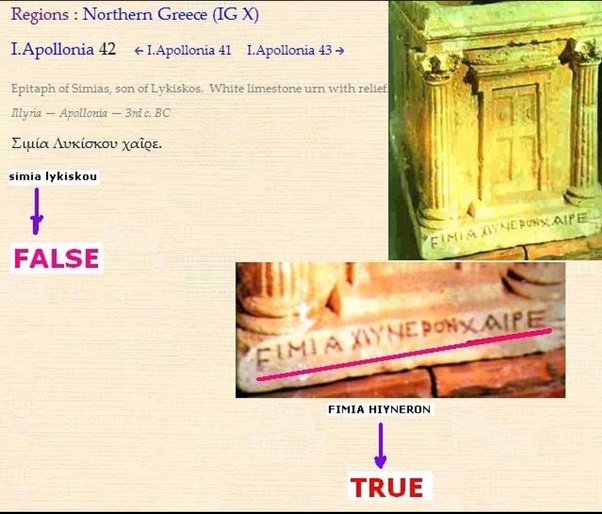
The falsification of the inscriptions transliteration in the “”Greek”” Corpus of Epigraphy?

Searchable Greek Inscriptions
A Scholarly Tool in Progress

The Packard Humanities Institute

Project Centers

Cornell University

Ohio State University

Project History

2 fjali


It is clearly visible not SIMIA LYKISKOI but FIMIA XIYNEPON(FIMIA HYJNERON)= The child deifies
The unusual word XIYNERON, which falls short of our expectation to be a "Greek" one,  possibly a variation of the ευχη (pray to the Gods),  "strangely" looks very Albanian: hyjneron a verb (3-rd singular) derived from the noun Hy-u=God, Deity
English (2 entries.)                                                                                        Shqip (2 hyrje.)
deity                                                                                   hyjni (sh hyjni), hy {m} (tsh hyu) (sh hyj)
God                                                                                                              hy {m} (tsh hyu) (sh hyj)

shkronja
The child is deified, let it be for the good.

FIRST ANCIENT TESTIMONY

In considering whether the Modern Greek language is a natural descendant of the Ancient one, I have complete confidence in replying in the negative. I have many reasons thinking this.
Although Modern Greek language is often credited or it often ‘credits’ itself, being a Hellenic dialect continuously spoken in the Greek family hearths, generation after generation, it doesn’t look to me it really happened. It was another place where this language has been continuously spoken: the Church.
Yes it’s been spoken from a limited number of middle class orthodox believers Ottoman families ,  of some high ranking Christian Church clergy and a very small minority of Christian educated [in the best case since the Byzantine Church artificially adopted the Koine (and not the Attic, like some people like to say) language for liturgic purposes. Other than that no one spoke Greek before Greece was a country .
The Koine itself was a semi artificial language, and was spread to the East mostly for liturgics and political and comercial purposes, and never represented the original language of the Hellenes, like it never represented the Hellenes themselves.
The exorbitant fantasy of the theory in which the Modern Greeks are

THE PELASGIAN ..........OUR NEIGHBORS

Many people have tried to explain the meaning of the word Pelasgoi or Pelasgian. We already know the inhabitants of Pelasgia ( Argos capital) were called Danaioi(Argives)  were named after their king Danaus.

DANAOI

In the historical sources, the Danuna are known by many different names such as Denyen, Danunites, Danaoi, Danaus, Danaids, Dene, Danai, Danaian.
These were the same people who attacked Troy and wrongly considered by the historiography as Hellenes(Greeks).
Danaus, or Danaos ( Δαναός), was a mythological character, twin brother of Aegyptus and son of Achiroe and Belus, a mythical king of Egypt. The myth of Danaus is a foundation legend of Argos, one of the foremost Mycenaean cities of the Peloponnesus. In Homer’s Iliad, “Danaans” (”tribe of Danaus”) and “Argives” commonly designate the ””Greek””” forces opposed to the Trojans.

ARGOS

Evidently Argeoi, Pelasgjoi, Danaidai, Mykenaoi, Argives, Pelasgos, Pelasgjikos, Pelasgjia, Argolis are interchangeable for each other. They represent the same people and land, the Pelasgians of Peloponnesus originally from Egypt. 
They inhabited a vast territory, mainly Peloponnesus and Epirus. That was the situation before the arriving of the real “Greeks” the Hellenes (Dorians). It’s logical that these Hellenes were just next to the Pelasgians (Danaoi, Argives, and Achaeans) before, and then subdued them. In other words they were neighbors to each other.
Being so, it’s normal that they could have been called our neighbor, by the Hellenes.
Let’s take a look at the word neighbor:


It’s evident that pelas means neighbor, and


woodhouse_0480

gjë or gja means land.
Thus PELASGIA literally means the land adjacent ours, or the neighbor land.
So Pelasgians are the neighbor of the Hellenes (Dorians or Heraclites, an Illyric nation)
Like we can see pelas is not the first correspondent word for the neighbor. The exact correspondent word is GEITON which is pronounced gjiton.
This pronunciation is totally the same with the Albanian word:

English (3 entries.)
  Shqip (3 hyrje.)
  neighbour, neighbor
  gjiton / gjitone
  neighbour, neighbor
  fqinj / fqinje
  neighbour, neighbor
  komshi / komshie (shumës komshinj)
The natural question would be: “Is the above word a loan from Greek”?
No. The Albanian word gjiton derives from the adverb ngjitur (in the Gheg dialect ngjit which means near, close by, adjacent to and/or from the adjective e ngjitur which is the same thing.

English (18 entries.)
  Shqip (18 hyrje.)
  adjacent
  i/e ngjitur, afër
The very source of this word is the Albanian verb ngjis:
Attach, close up, bring close to, bring near
  ngjis (kr. thj., pj. ngjita, ngjitur)
Do we have the correspondent word in ancient “Greek”. Yes we do

close

The word εγγύς is pronounced engjis.
Its obvious that the source of the word is the Albanian verb e ngjis which forms the place adverb ngjitur or ngjit(in gheg) or ngjitun(in gheg).

English (3 entries.)
  Shqip (3 hyrje.)
near (adverb)
  Pranë, ngjitur
near (adverb)
  Afër, ngjitur
next, next to
  ngjitur, ngjitur me
What is a neighbor?
Neighbor:
n.
1. One who lives near or next to another.
2. A person, place, or thing adjacent to or located near another.
v.tr.
To lie close to or border directly on.
v.intr.
To live or be situated close by.
adj.
Situated or living near another

The Ancient Greek language is always seen as a separate branch of IE languages.
That is not true. The truth is as the following:

  1. The Ancient Greek is not the language of the Hellenes
  2. The Ancient Greek is the language of the Pelasgians.
  3. The Ancient Greek is the language of the Pelasgian group of Egypt.
  4. Hellenes have spoken originally an Illyrian dialect.
  5. Ancient Greek (Pelasgian language) and Illyrian language have the same source (probably the later could be the source of the former).
  6. Most of the Hellenes lost their original language.
  7. The language of the literature(Attic, Ionic) is a conventional one its not the spoken language.
  8. Unlike most of the beliefs that language of the Hellenes evolved in the today Modern Hellenic, I strongly believe that the later one is artificial bastard imitation and morphologically unable to explain the former.
  9. Graicoi is not the same with Hellenes, Aristotle is definitely wrong.
  10. Graicoi are a mix Semitic-Thracian tribe while Hellenes an Arian migration.
  11. Hellenes represent the vanguard of the south Illyrian tribes returning back in the Peloponnesus which was their land before the invasion of the Egyptian Pelasgians.

PA

Since Ventris “”deciphered”” the Mycenaean Scripts nobody was interested anymore to develop some thorough study in the already “known” languages like for ex. "Ancient Greek””.
Now people who study grammar and orthography of the Ancient Greek language is very familiar to the diacritic marks placed above the initial vowel in different words. The linguists already know the meaning of them like ā or ă placed above alfa. According to the linguists they are used to show either a long vowel or a short one. They explain also some other strange marks meaning: “the signs placed above the initial vowel indicate the presence of an aspirated sound or the absence of an additional sound”. They are called breathing. In other words breathing always occur before the first vowel sound of a word, and are either hard or soft.
They are indicated by either a ‘ or a ` over the first vowel. The former (hard) indicated an aspirated vowel (in other words, pronounce the word as if it began with an English “h” sound. The latter (soft) means there is no “h” sound, and simply pronounce the word as written (Oxcord University Press. ISBN 0-19-514956-4)
Let’s take a quick look at them:
῾
Aspirate or rough breathing: a sign placed over an initial vowel or initial rho to indicate an initial h-sound
Thus between the linguists is establishet that because of that mark the above words are pronounced helios and hodos. To justify that they give the following explanation:

In the old Attic alphabet Η or heta represented the h-sound. In the Ionic alphabet, the same symbol represented a vowel, eta, because the Ionic dialect had lost aspirations and had no need for heta.


THE “IGNORANCE” OF THE ‘QELESHE’

It has always been an interesting case in the scholars works, studying  words with an unical meaning, whose cognates in other languages do not  exist, even inside the same languages families.
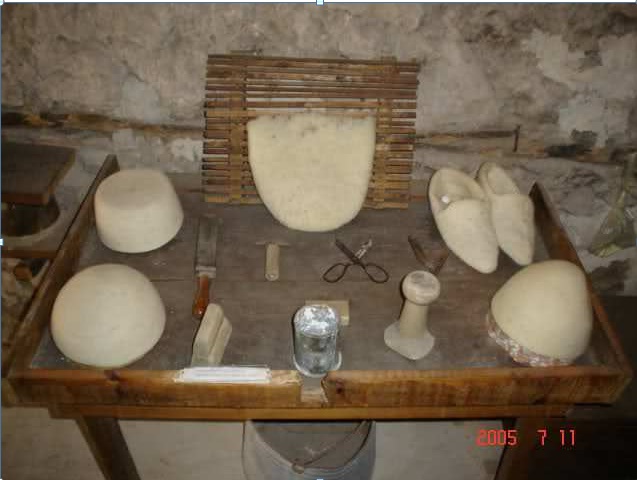
Let’s see one of them . The word ‘qeleshe‘ in Albanian is unical, like it’s unical the object it represents.

Different types of the Albanian ‘qeleshe’
1fjale

What a qeleshe is?
A qeleshe is a traditional skull cap, which 

Four sides of the horizon speak Albanian


Four sides of the horizon speak Albanian.

In all cultures, the horizon directions, which serve for spatial and time orientation, for construction and for many other purposes, are defined historically by the movement of the sun, or meteorological factors that these directions are related.
Everyone knows, that North in Northern Hemisphere is synonymous with the cold, and is the North which brings the cold winds, snow and ice. Of course, that it is valid for the Balkan region too, the cold wind and snow always come from the North, hence the  Albanian word Veri(north) expresses exactly this vje + ere(winds come), which is reduced in one adjacent name Veri, in a way  fully submissive of Albanian language principle.
Since the North Wind is the wind of the snow, thus the cold wind, which in ancient time it had been called boreas or boras.


English (2 entries.)
  Shqip (2 hyrje.)
  snow
 borë {f}, dëborë {f} bora {tr. shq}


Meteorologists and climatologists have certainly called like this the North Wind to the northern Balkans: